

 By
By A sketchbook can look like a collection of unfinished ideas—quick drawings, colour experiments, rough compositions and even pages that didn’t quite work.
But for an aspiring artist, it can be the beginning of something much bigger.
Art schools don’t simply look for students who can draw beautifully. They often want to see creative thinking, technical development, experimentation, originality and the ability to communicate ideas visually.
That is why the journey from a sketchbook to a portfolio matters.
For students considering art, design, illustration, animation, architecture or other creative fields, well-structured drawing classes in Miami can provide an environment where those skills develop gradually—and where experimentation becomes part of the learning process.
Your Portfolio Starts Before You Build It
Many students think about a portfolio only when an application deadline approaches.
That’s usually too late.
A strong portfolio is built over time. It reflects how an artist thinks, explores ideas and develops their skills.
A sketchbook is therefore much more than a place to practise drawing. It can become a visual record of the creative journey.
Students might use it to:
- Develop initial concepts
- Explore different compositions
- Test colour combinations
- Practise perspective and proportions
- Experiment with materials
- Record observations
- Refine ideas through multiple versions
Not every page needs to be portfolio-ready.
In fact, some of the most interesting pages may be the messy ones.
1. Building Strong Artistic Foundations
Before experimenting with advanced techniques, students need a solid understanding of fundamentals.
Drawing, colour theory, composition, perspective, light, shadow, form and proportion are essential building blocks for many creative disciplines.
A structured art class gives students the opportunity to practise these skills consistently rather than trying to learn everything at once.
For example, a student interested in character design might begin with basic observation drawing. Over time, they can progress towards gesture drawing, anatomy, expressions and eventually original characters.
That progression becomes visible in their work.
And progression is valuable.
2. Learning to Develop an Idea
Imagine a student receives the assignment:
“Create an artwork inspired by Miami.”
The first idea might be obvious—palm trees, beaches and bright colours.
But what happens next?
A good art-learning environment encourages students to ask better questions.
Could Miami be represented through architecture?
What about its multicultural communities?
Could the city’s nightlife become an abstract composition?
Could street art, ocean life or local textures become the inspiration?
Portfolio development is not simply about producing attractive images. It is about learning how to take an idea somewhere interesting.
3. Experimentation Makes a Portfolio Stronger
Imagine opening two portfolios.
The first contains twenty pieces that all look almost identical.
The second contains observational drawings, mixed-media experiments, paintings, sketches, studies and several different approaches to composition.
Which one tells you more about the artist?
Experimentation can reveal curiosity and creative confidence.
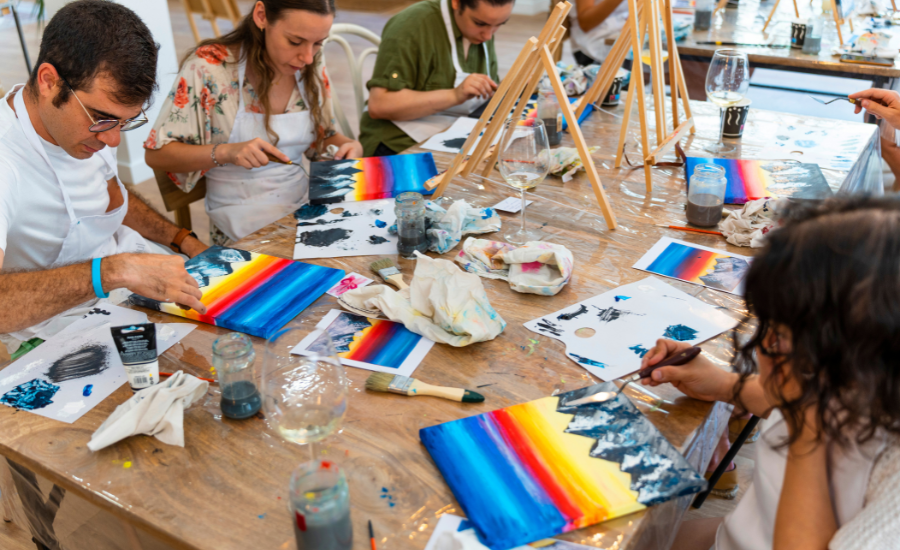
Students attending art classes in Miami can explore different materials and techniques before deciding which ones best represent their artistic voice.
They might work with graphite one week, acrylics the next and mixed media later.
The objective isn’t to master everything.
It’s to discover possibilities.
4. Learning How to Select Your Best Work
Creating artwork is one skill.
Knowing which artwork belongs in a portfolio is another.
Students can eventually learn to review their work critically and ask:
Does this piece show a skill I want to highlight?
Does it demonstrate something different from the other pieces?
Does it show development or experimentation?
Does it represent my artistic interests?
This process teaches students to become editors of their own creative work.
Instead of filling a portfolio with everything they’ve ever created, they learn to make thoughtful choices.
5. Process Can Be Just as Interesting as the Final Piece
A finished painting might look impressive.
But what if you could see how it evolved?
Initial sketches.
Colour tests.
Rejected compositions.
Material experiments.
Changes to the concept.
The final artwork.
Showing this process can communicate something important: how the artist thinks.
That is why maintaining a sketchbook can be such a useful habit for students preparing for creative education.
It captures the thinking behind the artwork—not just the finished result.
6. Constructive Feedback Builds Creative Confidence
One of the advantages of learning in an art-class environment is feedback.
Students can become so familiar with their own work that they stop noticing opportunities for improvement.
A teacher can provide another perspective.
Perhaps the composition needs more balance. Maybe the colours are competing with the subject. Perhaps an interesting idea could be developed further.
Constructive feedback shouldn’t remove the student’s creative voice.
It should help strengthen it.
Over time, students can also learn to critique their own work—which becomes an important part of artistic growth.
7. Exploring Different Creative Directions
Not every aspiring artist wants to become a traditional painter.
Today’s creative education can lead in many directions.
Students may eventually explore:
- Illustration
- Graphic design
- Animation
- Fashion design
- Architecture
- Photography
- Digital art
- Fine art
- Concept art
- Product and visual design
Early exposure to different artistic approaches can help students understand what genuinely interests them.
That discovery can influence both the work they create and the direction of their future portfolio.
8. Developing a Portfolio Mindset Early
A portfolio shouldn’t feel like a last-minute collection of “good drawings.”
It should tell a story.
Where did the idea begin?
What did the student experiment with?
What skills have they developed?
What subjects and themes interest them?
What makes their work recognisably theirs?
This mindset can transform the way students approach everyday assignments.
Instead of thinking, “I just need to finish this project,” they can begin thinking, “What can I learn from this project?”
From Practice Pages to Creative Direction
A portfolio is never just a folder of artwork.
It represents a student’s creative journey.
The quick sketch in a notebook today could become the foundation for a larger project tomorrow. An unsuccessful painting might teach an important lesson about colour. A simple observation drawing might eventually lead to an interest in illustration or character design.
That is why starting early can be valuable.
With the right guidance, art classes in Miami can help students move from simply making artwork to understanding why they create it, how they can improve it and where their creativity might take them next.
The goal isn’t to produce a perfect portfolio overnight.
It’s to develop the artist behind it—one sketch, one experiment and one idea at a time.