

 By
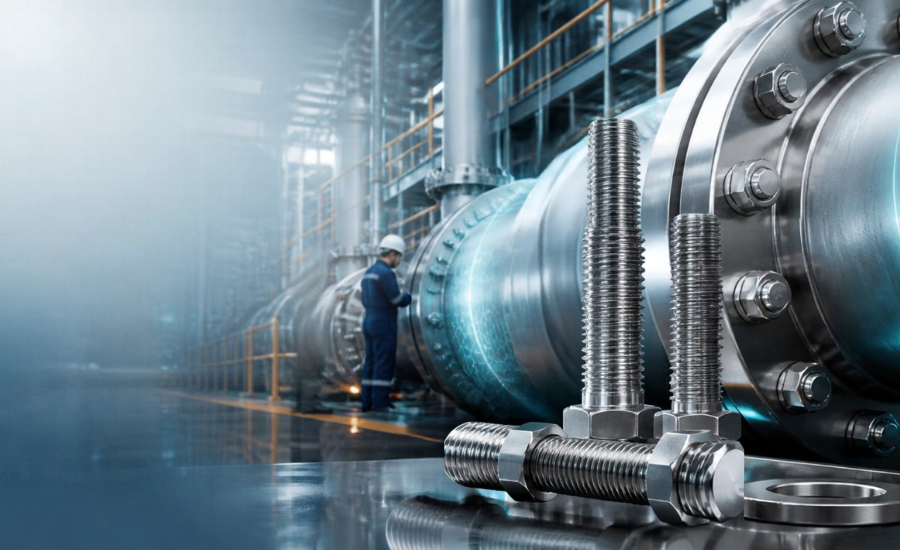
By In industrial plants, fasteners may be small components, but their reliability can have a major impact on equipment performance and maintenance. Stud bolts are widely used for securing flanges, valves, pressure vessels, piping systems and other critical connections. When these components are exposed to moisture, chemicals, heat or aggressive process environments, corrosion can gradually weaken the fastening system.
Corrosion-resistant stainless steel (SS) stud bolts offer a practical solution for applications where conventional carbon or alloy steel fasteners may require frequent protection or replacement. ASTM F593, for example, covers stainless steel bolts and studs in several alloy groups intended for applications requiring general corrosion resistance.
Resistance to Corrosive Environments
Industrial facilities can expose fasteners to humidity, chemicals, salt-laden air, process fluids and other corrosive conditions. Once corrosion begins, threaded surfaces can deteriorate, making inspection, tightening and eventual removal more difficult.
Stainless steel grades such as 304 and 316 are commonly selected for their corrosion-resistant properties. ASTM F593 specifically includes both 304/304L and 316/316L stainless steel groups for stud and bolt applications.
For environments containing chlorides or marine exposure, appropriate material selection becomes particularly important. Higher-alloy stainless steels may be considered where the service conditions demand greater resistance.
Better Reliability at Critical Connections
Flanged connections depend on correctly selected and properly installed fasteners to maintain the required clamping force. Corrosion affecting threads, nuts or the exposed portion of a stud can interfere with joint maintenance and potentially compromise connection reliability.
Using suitable SS stud bolts can help maintain the condition of the threaded connection over a longer service period. However, corrosion resistance should always be considered alongside tensile strength, temperature, pressure, chemical exposure and the requirements of the specific application.
Reduced Maintenance Requirements
Corroded fasteners can become difficult to loosen during maintenance or shutdown activities. In severe cases, threads may seize or deteriorate, increasing the time and effort required for replacement.
Corrosion-resistant stud bolts can reduce the frequency of fastener-related maintenance in suitable environments. This can be particularly valuable in plants where equipment shutdowns are costly or access to piping and machinery is difficult.
The result is not simply a longer-lasting fastener; it can also contribute to more predictable maintenance planning.
Supporting Plant Safety
Fasteners are part of the overall integrity of a piping or equipment connection. If corrosion significantly affects a stud bolt, the condition of the complete joint needs to be assessed.
Selecting corrosion-resistant fasteners for the service environment can therefore form part of a broader preventive maintenance and equipment-integrity strategy. Proper grade selection, installation torque, inspection and compatibility with the connected materials remain essential.
It is also important to consider galvanic corrosion when stainless steel fasteners are connected to dissimilar metals. Appropriate isolation methods may be required depending on the design and operating environment.
Choosing the Right Stainless Steel Grade
There is no single stainless steel grade suitable for every plant application. Factors such as chloride concentration, chemical exposure, temperature, mechanical loading and operating conditions should be evaluated before selecting a stud bolt material.
For example, 304 stainless steel may be suitable for many general corrosion-resistant applications, while 316/316L can be considered where greater resistance to chloride-containing environments is required. ASTM F593 recognises several stainless steel alloy groups for stud and bolt applications, including 304, 316, 321, 347 and other grades.
The corresponding nut material is equally important. ASTM F594 covers stainless steel nuts intended for general corrosion-resistant applications and identifies compatible alloy groups.
Longer Service Life and Lower Replacement Risk
Replacing a failed or heavily corroded fastener can involve labour, equipment isolation and plant downtime. Choosing an appropriate corrosion-resistant stud bolt at the design or procurement stage can help reduce these risks.
For this reason, SS stud bolts are widely considered for applications across chemical processing, water treatment, food processing, marine environments and other industrial facilities where corrosion resistance is an important requirement.
A Small Component with a Significant Role
SS stud bolts may represent only a small part of an industrial installation, but their role in maintaining secure mechanical connections should not be underestimated. By combining suitable corrosion resistance with the required mechanical properties and correct installation practices, they can support equipment reliability, easier maintenance and longer service life.
For plant operators and engineers, the key is not simply choosing stainless steel, but selecting the right stainless steel grade and fastener specification for the actual operating environment.